Congratulations, your song is on Spotify. As an artist this marks
the official start of your career. And all your hard work will soon
be paid off. But how much money are you entitled to?
01
Your song
The music industry is a complicated industry with many confusing
things. Because of this a lot of questions arise. Unfortunately
there are no short and simple answers and the answer can change case
by case.
Repertoire wants to solve some of these problems by addressing the
entire flow from musical work, sound recordings, licensing and
rights associated with payment flows.
Instead of starting from the beginning when the song was written and
recorded, we will start with the finished song on Spotify. We do
this so we can literally follow the money back to the artists.
02
Digital radio
So your song is on Spotify, an
interactive digital radio. This means that a listener
can control which song they want to listen and in what order, at any
moment.
When listening to the radio a big difference arises between digital
radio and terrestrial radio. Terrestrial radio is a classic FM or AM
radio where a dj chooses the song and the listener can only listen
to those songs, it’s a non-interactive process.
The digital radio is radio via the internet and is divided between
the interactive radio and the
non-interactive digital radio. Non-interactive radio
works the same as terrestrial radio. It won’t let the user choose
what songs to listen to and in what order.
03
Record label
Okay, now that we know more about what Spotify actually is, we can
take a look at how the royalties are divided.
The interactive digital radio, like Spotify needs to pay the
copyright holders of the recording, which in most cases is the
record label. These are called recording performance
royalties. The record label will also have to pay songwriter and
composer, royalties earned for each record sale, they are called
mechanical license fees. If the songwriter and composer are the same
person as the performer all these royalties go to the same person
via a different way.
04
Performer
So Spotify paid fees to the record label, but the artist still isn’t
paid. Luckily this is a fairly straight process. The
performer signs to a record label, and gets studio time
to record the song from the record label. Depending on the contract
the performer can get a lot of different perks from the record
label. They could also record a video clip for the song, promote the
song and pay for a tour for instance. The record label gets in
return the royalties of the song. The record label then pays the
performer back a portion of the money they receive. The amount the
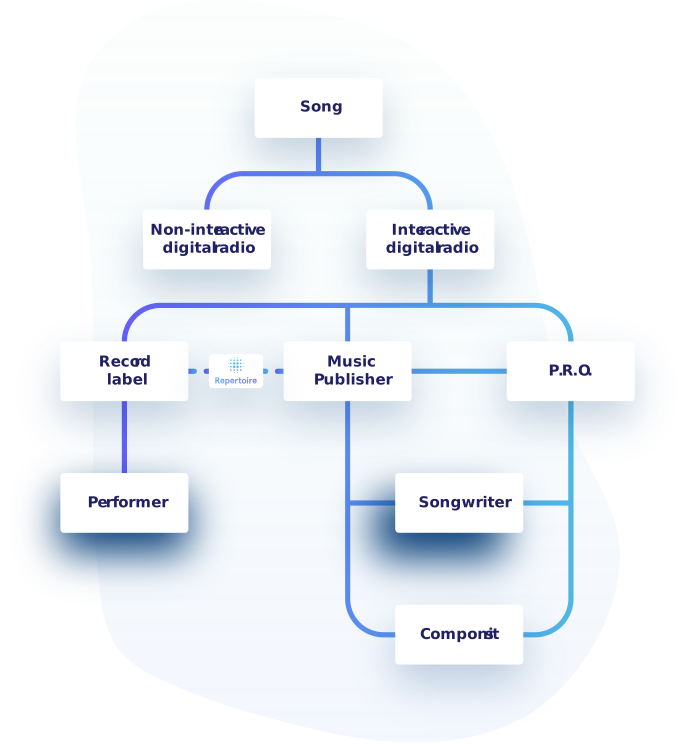
performer gets depends on the contract they sign. This explanation
has been very zoomed in on every individual of this story, but for a
better overview this graphic might help!
more info
Repertoire has created a blockchain solution where performers,
composers and songwriters can upload a new piece of information
whenever it is created. This information can be a sound recording,
a melody, just the recording of the piano or even just some
lyrics. It can be anything that has just been created. The whole
idea behind this is that this information is safely secured
somewhere to avoid legal issues in the future. It’s the perfect
way to stay in your creative flow but still be done with the legal
stuff! If you want to learn more about Repertoire visit their
website.
05
PRO
Now that we have taken a look at the record label side of the story,
we can dive into the publisher, songwriter and composer side.
Spotify also needs to pay royalties to the songwriters, composers
and music publishers. These payments go to the
Performance Rights Organizations (PRO’s) first. PRO’s
are organizations who negotiate and collect royalties when
songwriters and composers’ songs are publicly performed in a
broadcast, on the internet, or a physical live performance. These
payments are songwriting performance royalties. In America ASCAP,
BMI and SESAC are PRO’s.
06
Music publisher
The party who signs up to a PRO’s is a
music publisher or a composer. The reason
they do this is so their songwriters and composers get their
performance royalties. So what does the music publisher do? The
music publisher’s job is to market and promote the songwriters and
composers songs resulting in exposure. They pitch the songs to
record labels, television producers, etc. When the music publisher
finds someone who’s interested in using the song or lyrics they also
license the rights over so the other party can use the song or
lyrics and the music publisher can collects the money for the
usages.
Typically the music publisher takes over the possessions of the
copyrights so they can collect the royalties themself and later pay
a agreed opon portion back to the writers/composers.
more info
Whenever a songwriter or composer needs to get payed, it will be
easily traceable who worked on the music even if it accidentally
happens that a composer or songwriter is excluded from the
project. This is because the specific piece of information where
this composer or songwriter had worked on is uploaded on
Repertoire and due to the use of blockchain information can’t be
altered without being noticed by others. So you don’t have to
worry about others stealing your work anymore! If you want to
learn more about Repertoire visit their
website.
07
Song writer & composer
Now we have finally come down to the creation of the song, the job
of the songwriter and the composer. When a
songwriter writes a song or a composer composes a song they can sign
with a music publisher. There are a many different contracts they
can sign. Contracts differ in services the music publisher will do
for the songwriter and composer. Of course there will also be a
difference in the percentage the music publisher keeps for
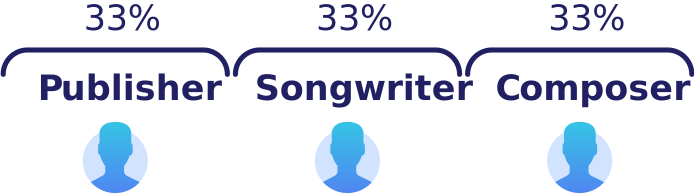
themselves. Traditionally the split is 50-50 in the USA. In Europe
this split is 33-33-33. This explanation has been very zoomed in on
every individual of this story, but for a better overview this
graphic might help.